-
Public sector
Public Administration in a Time of Transition: Is Your Toolkit Built for Reality?

The world is changing faster and becoming more complex than the tools in the government’s traditional "catalogue" were ever designed to handle.
Over time, our colleague Paul Chaffey has posed a searching question to leaders within the bureaucracy: Are we well-enough equipped to solve the "wicked" and tangled problems we face, or are we trying to solve tomorrow's challenges with yesterday’s methods?
Through contributions to the Ministry of Digitalisation and Public Governance (DFØ) and the National Evaluation Conference, Paul has highlighted the urgent need to rethink how the public sector is equipped to meet complex, cross-sectoral challenges - the kind that simply cannot be solved within traditional silos.
Acknowledging Complexity
The Norwegian government’s strategy, "Good individually, best together" (Gode hver for oss, best sammen), describes a landscape defined by increased focus on security, dwindling resources, the climate crisis, and a staggering pace of technological development.
Paul Chaffey describes this as a "time of transition." Threats to national security, artificial intelligence, and demographic shifts do not hit us as isolated incidents; they are interwoven "floker" (tangles) that demand a unified response.
Here are the two primary insights from Paul’s ongoing dialogue with the public sector:
1. We must understand the nature of the problem we are solving
Many failures in the public sector occur because we categorize problems incorrectly. We often treat complex challenges as if they were either clear (solvable through best practice) or complicated (solvable by a group of experts).
To navigate this, Paul frequently utilizes the Cynefin framework. It helps us distinguish between different domains of reality:
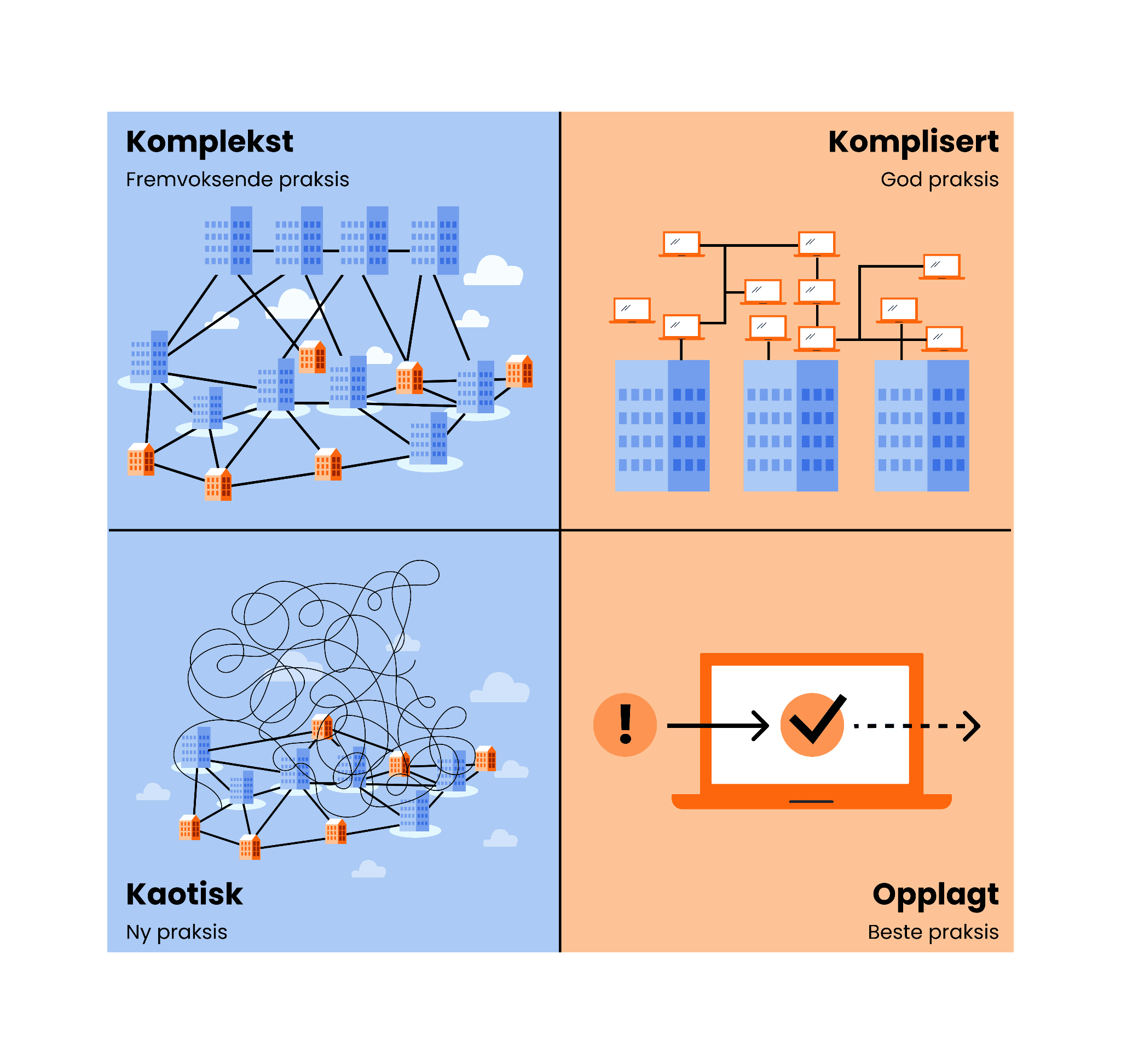
The Clear: This is the realm of "best practice." We’ve done it before, we know it works, and the result is predictable.
The Complicated: This requires expertise and analysis. We don’t have the answer immediately, but we know the process to find it.
The Complex: Here, multiple actors and variables influence each other in unpredictable ways. Linear plans fail here; we need curiosity, experimentation, and cross-sector collaboration.
The Chaotic: In this state, the relationship between cause and effect is unknown. We must act quickly to establish order (as seen in the early weeks of the pandemic).
If we apply traditional management models to complex challenges - such as social exclusion or national security - we risk wasting enormous resources on solutions that don’t work, or worse, make the situation more precarious by ignoring the bigger picture.
2. From linear plans to an expanded "toolkit"
Traditional government methods often lack the tools for the unpredictable. When trend projections and socio-economic analyses no longer provide the answers we need, we must expand our toolkit.
Paul argues that public administration must train leaders and employees in more dynamic methodologies. To be resilient and adaptive, a modern administration needs the following:
Problem Diagnostics: The ability to distinguish between simple and complex problems before choosing a method.
Experimentation and Prototyping: Testing concepts on a small scale to learn quickly, rather than rolling out massive reforms that might miss the mark.
Systemic Design: Tools that make it easier to see and understand the connections between sectors, legislation, and digital ecosystems.
Scenarios and Visioning: Exploring potential futures to understand the consequences of decisions before they are made.
Visualization as Decision Support: Making complex connections understandable through visual narratives, ensuring all stakeholders share the same situational awareness.
Facilitated Co-creation: Processes that extract knowledge across silos, creating a far better foundation for decision-making than traditional meetings.
Design as a Powerhouse for the Public Sector
There is a clear common thread between Paul Chaffey’s analysis and Halogen’s approach to design. Whether it involves new legislation for children’s rights or the future of healthcare, the goal remains the same: To release the creative power inherent in law and bureaucracy.
At Halogen, we exist to support ministries and agencies in navigating this era of transition. Through systemic design and exploratory methodologies, we help build a society that actually works for the people living in it.
Want to know more about how to equip your organization for the future? Get in touch with Paul Chaffey for a tour of the designer’s toolkit.

Paul Chaffey
Special advisor
paul.chaffey@halogen.no